
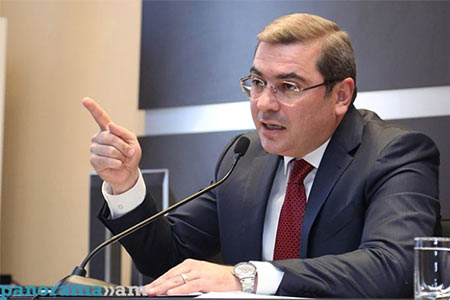
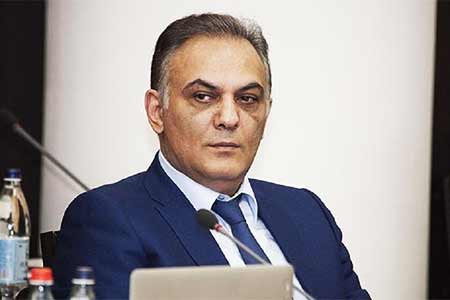
ArmInfo.Armenia currently faces a simultaneous crisis of legitimacy, the rule of law, and statehood. Only the consolidation of the opposition around a unified national identity can lead the country out of this crisis, according to David Ananyan, former Chairman of the State Revenue Committee of Armenia and a member of the "Wings of Unity" party.
The politician noted that there are historical moments when the external trajectory of political events can be deceptive. He observed that while it may appear that elections in Armenia have concluded, mandates have been distributed, post-election tensions have subsided, relative calm has been established, and the government is allocating positions as political forces reorganize to find a way forward, the reality is quite different.
"In reality, beneath a veil of silence, something completely different is happening deep within the country. The foundations of the state are cracking. Since June 7, Armenia has reached exactly this dramatic threshold. The current situation is a simultaneous crisis of legitimacy, the rule of law, and statehood. When these three crises coincide, the state begins to exist more in its external forms than in its internal substance," Ananyan stated.
According to him, the current Armenian government controls public administration and the system of power, the courts, and the parliamentary majority, but this control does not yet constitute statehood. The politician emphasized that the state exists as long as the government is based on trust, justice, and a sense of shared destiny.
Ananyan is convinced that when these foundations are lost, the government transforms into a self- preservation machine, masking its legitimacy crisis with new repressions, criminal prosecutions of dissenters, and the cultivation of public fear. "From this point on, repression ceases to be a political choice and becomes the system's primary means of survival. However, the crisis affects more than just the government. The entire opposition faces an equally critical choice. Parliamentary and extra-parliamentary forces must decide whether they can form a unified platform and a unified program of struggle, or whether they will instead opt for decentralized resistance," he continued in a post on his Facebook page.
The "Wings of Unity" representative believes that a unified struggle undoubtedly leads to the concentration of power, but a decentralized struggle can also be effective if it doesn't devolve into private ambitions, mutual neutralization, and endless competition for the same audience.
He believes that it's not necessary for everyone to be in the same structure, stand on the same stage, or speak the same language. However, it is essential that these independent programs be synchronized, complementary, and directed against the same systemic problem.
"The forms of struggle may vary, but the essence of the struggle cannot be contradictory. The foundation uniting these different paths must be national—not in the sense of a cliche used in speeches, but as the protection of our state identity, historical memory, sovereignty, and right to exist. This must be anti- Turkish—not in terms of hostility toward peoples, but in the sense of rejecting the Turkish-Azerbaijani expansionist policy toward Armenia, the rewriting of history, and the agenda aimed at suppressing the will of our national resistance," Ananyan clarified. According to the politician, the struggle must be anti-government—not out of personal hatred or a desire for revenge, but as a fight against a system that internally presents external coercion as peace, retreat as realism, and national self-abnegation as state wisdom.
"Today, the question is not even whether the struggle will be unified or decentralized. History often does not even ask nations if they are ready; it simply places them mercilessly before a choice. Today, our choice is between the state and the system, between national resistance and adaptation to defeat. All other differences are temporary. This choice is fateful," Ananyan concluded.

















 Expert: Azerbaijan`s political leadership states `occupation of Armenia is their new national goal`
  Expert: Armenian society falls into security trap of totalitarianism
 Expert: Pashinyan`s visit to Russia creates prerequisites for restoring dialogue, but thaw in relations is more symbolic
 Human rights activist Ruben Melikyan dismissed from YSU
 Zakharova: Armenia`s pro-EU pivot poses economic security risks to EAEU member states
 It`s time for South Caucasus countries to think of South Caucasus as single, unified region - RA premier
  Pashinyan: Armenia and Azerbaijan should leave each other alone
 Moscow sees situation with Armenia as attempt to attack Russia-involving integration associations - Russian presidential aid
 Zakharova: Armenia views relations with Russia as tool for financially securing reorientation toward EU
 The Armenian Minister of Justice and the EU Ambassador discussed visa liberalization issues for Yerevan.
 Azerbaijan`s aggressive plans against Armenia became possible in wake of Pashinyan`s decisions on Artsakh - expert
  Zakharova: Russia sent a note of protest to Armenia over the act of vandalism at the "Mother Armenia" memorial in Gyumri
 Samvel Karapetyan proposes creating a post-election opposition coalition
 Artsakh`s Cultural Heritage Ombudsman called on Moscow to respond to destruction of WWII monuments by Azerbaijan in occupied NKR
 Prosecutor General`s Office petitions Central Electoral Commission for criminal prosecution of Robert Kocharyan
 Dutch Prime Minister expresses his support for Armenia`s democratic reform and economic diversification agenda
 Heritage: It`s time for Armenia`s opposition to present people with legitimate alternative to power